The Terracotta travel guide
The King Across the Street
Batonis Tsikhe, Erekle II and the century that shaped Telavi
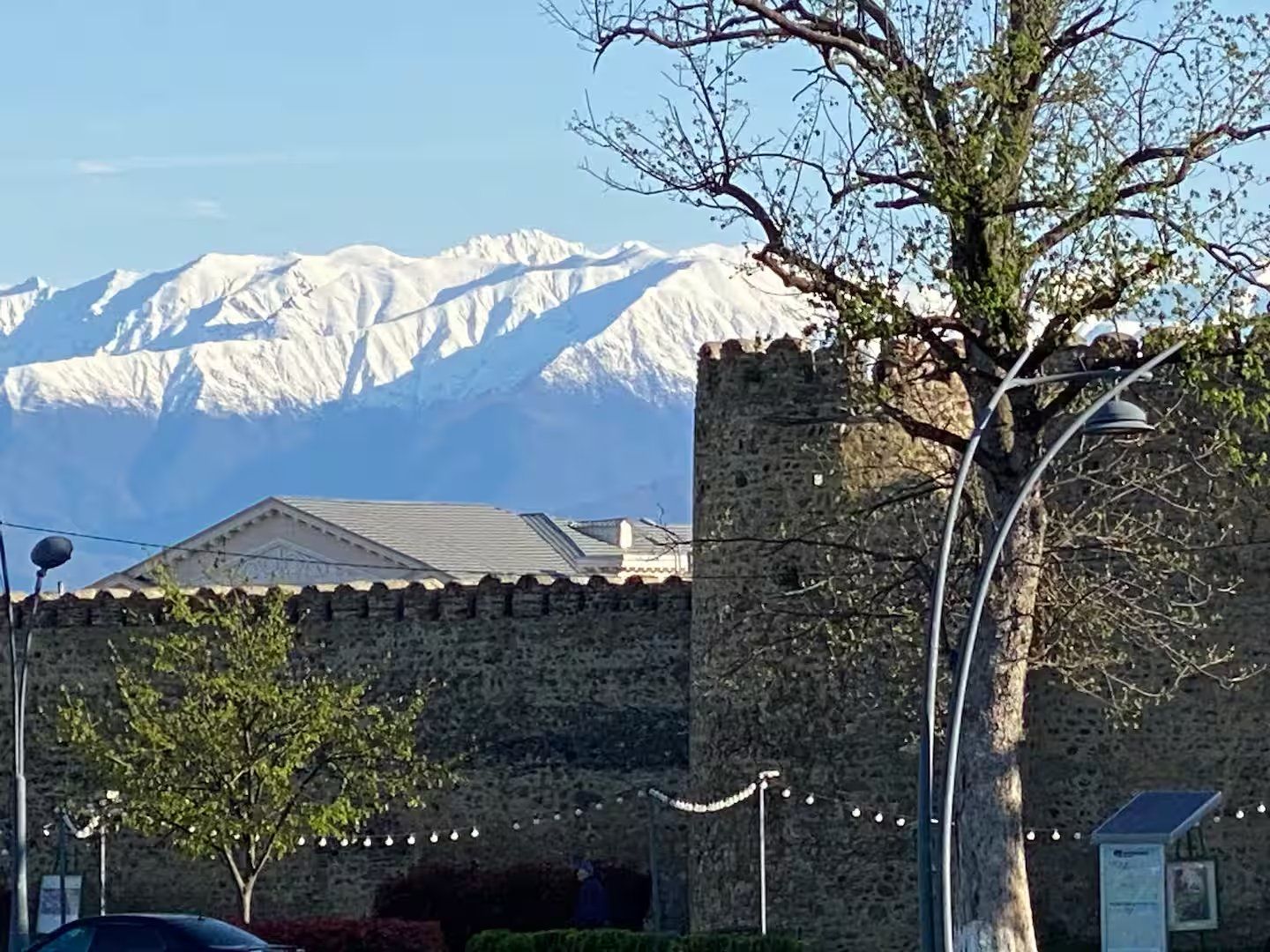
Every place to stay has a view. Ours happens to be a royal fortress. But the longer you live opposite Batonis Tsikhe, the more the question presses: who actually lived behind these walls, and what happened here? This is the short, honest version — written with unusual confidence, because one member of our family researches exactly this period for a living.
The fortress of the master
Batonis Tsikhe — the name means "the fortress of the master" — began under King Archil in the 17th century. Within its walls stand royal palace buildings, two churches, fortification walls and the remains of a bathhouse; today the complex also houses a history museum. It is one of the best-preserved royal complexes in Georgia, and it sits in the middle of a living town rather than behind a ticket gate.
Erekle II: the king in an age of empires
The fortress reached its height under Erekle II (1720–1798). King of Kakheti from 1744, later ruler of the united kingdom of Kartli-Kakheti, he governed in one of the hardest centuries a small Caucasian kingdom could face — squeezed between the Ottoman Empire, Persia and an expanding Russia.
From these walls, Erekle reformed the administration and the army, supported schools and printing, and pursued a policy that historians describe as an attempt to connect his kingdom to the intellectual currents of its age. In 1783 he signed the Treaty of Georgievsk, placing his kingdom under Russian protection — a decision that shaped Georgia's fate long after his death. He is remembered as a warrior-king who also believed in books, law and learning: a reformer in a fortress.
The walls you see from our windows were shaped by the reign of a king who wanted his small kingdom to think bigger.
Why we can tell this story carefully
One of us — Tilmann Kulke, the historian in the family — works on exactly this era. He earned his doctorate at the European University Institute in Florence in 2016 and is an Associate Professor at Ilia State University in Tbilisi, researching global intellectual history and the exchange of knowledge between cultures. Together with the Georgian scholar Nino Doborjginidze, he examined how Erekle's reforms connected this Caucasian kingdom to the wider world of the Enlightenment — the chapter "Erekle II (1720–1798) Goes Global" in the volume From Florence to Goa and Beyond (2022).
To be clear about what this means and what it does not: our house was not the king's house, and no crown jewels hide in our courtyard. What we have is the view, the neighbourhood — and a family member who can tell you, over coffee, what the documents actually say.
Reading the town through the fortress
Once you know the outline, Telavi changes. The plane tree's legend (Erekle resting beneath it) suddenly has a face. The street names sharpen. The bathhouse ruins inside the walls stop being scenery and become a Tuesday afternoon in the 18th century. That is the quiet gift of staying opposite a place like this: history here is not a museum label. It is a neighbour.
For those who want more
The Erekle feature page on this website goes deeper into the historian's research, with links to his academic profile and the publication. And the fortress itself — its museum, its churches, its walls — is across the street, waiting.
Sources & further reading
- Tilmann Kulke — faculty profile, Ilia State University
- Batonis Tsikhe — georgia.travel
- Doborjginidze & Kulke, 'Erekle II (1720–1798) Goes Global', in: From Florence to Goa and Beyond (EUI Press, 2022)
A base in the heart of it all
Terracotta sits in the historic centre of Telavi, opposite the royal fortress — two bedrooms, two bathrooms and a courtyard, made for exploring Kakheti.